


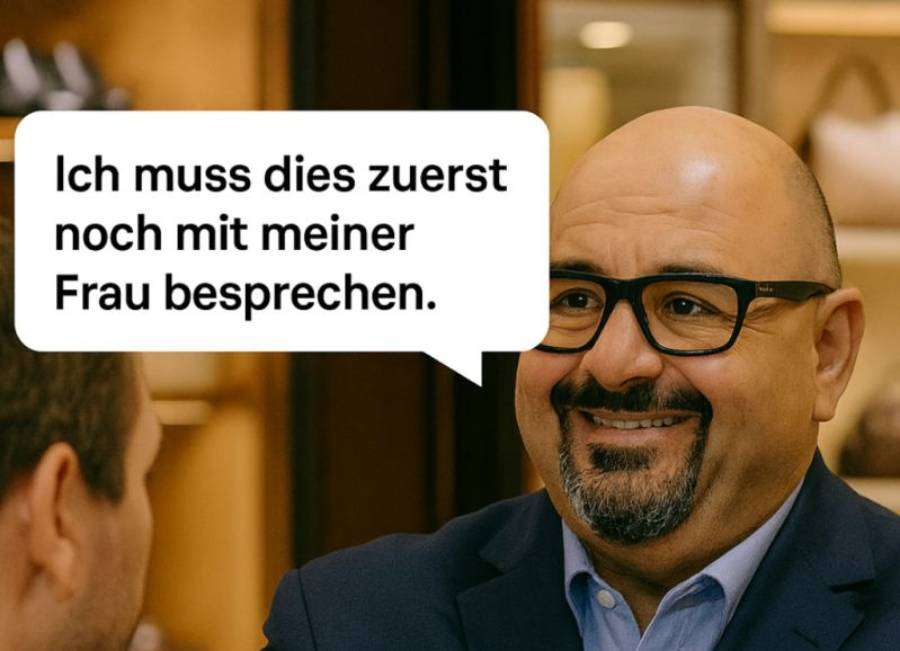

A sentence that every salesperson has certainly heard before.
Sympathetic, respectful and seemingly quite normal.
But if you listen more closely, you will notice that this is not just a statement. It is an objection and often a polite form of a “no”.
Because hand on heart: If you really want something, if you are inwardly convinced, if you are emotionally involved, you don’t discuss for long, you decide.
In sales training courses at FinOptima, we therefore call this objection the “shift key”. He signals: I’m not really convinced, so I’m looking for a reason to gain time. Or to reject in a friendly way without really rejecting.
What to do in such a moment?
Don’t push, don’t persuade and certainly don’t ridicule (“Oh, are you even allowed to decide for yourself?” – please don’t!). Instead, creating clarity with sensitivity is the motto here.
An example from a recent training course in Lugano: A participant from the luxury retail sector told me: “I had a customer who, after an intensive conversation, said he had to talk to his wife first. In the past, I would have said: Sure, I understand. May I contact you again next week?”.
This time I also asked: “What exactly do you want to discuss with her? Is there anything that is not yet coherent from your point of view? Something that still makes you doubt?”.
The effect? The customer became calm and said: “To be honest, I’m not quite sure myself if it’s the right moment.”
Now we were in real conversation.
Because behind the pretended marriage argument, the real issue is often hidden: insecurity. And that’s exactly what you can only address if you recognize them.
The truth is that many objections are not factual obstacles, but emotional brakes. If you want to make an impact in sales, you need one thing above all: the courage to listen behind the words, to address the topic openly and to offer empathetic (decision-making) assistance. After all, customers don’t buy when everything fits perfectly. They buy when they feel safe and understood. Secure in the decision, secure with the relationship, safe in conversation. And security does not come from arguments, but from trust.
Salespeople who understand this create connections instead of resistance and conduct sales talks in which decisions do not have to be postponed. However, it is very important not to exert pressure and instead to invest your own energy in building trust.
Because those who recognize the real reason for an objection are not selling against resistance, but with effect.
What typical “bogus objections” do you encounter again and again and how do you deal with them?
“Unleashing potential – celebrating success.”
