


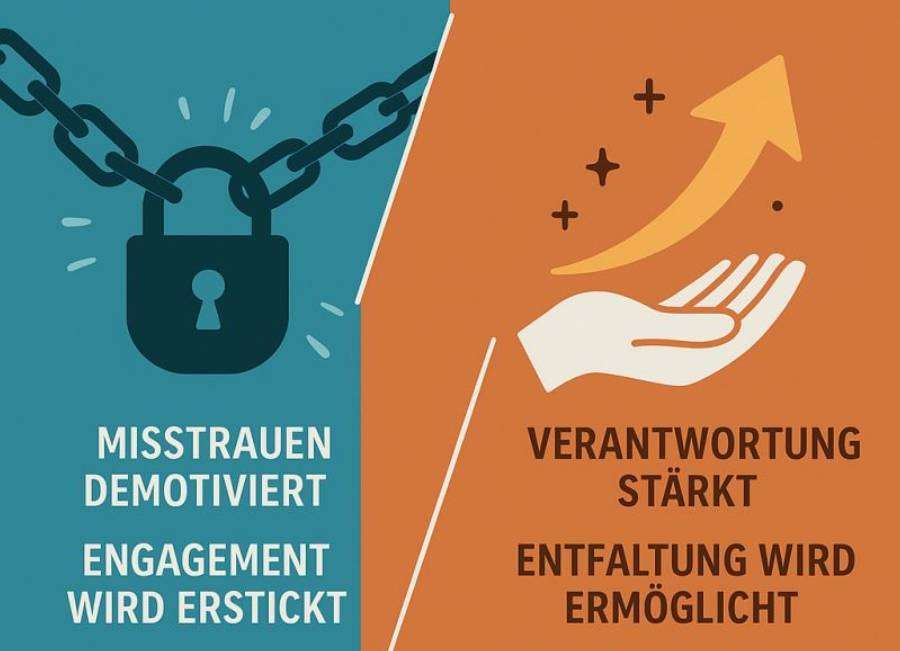

At the beginning of 2024, I accompanied a company in the retail sector that was struggling with high turnover. The managers were convinced that they had everything under control with daily checklists, rigid reports and a close-knit view over each shoulder.
The result? The best employees left. Not because they did not master the work, but because they felt patronized.
Why control is so seductive:
Many managers cling not out of malice, but out of insecurity. They believe that control guarantees quality. Behind this is often the fear of letting go. But exactly the opposite happens: overcontrol signals mistrust and that acts like poison for motivation.
Research confirms this: micromanagement significantly reduces the intrinsic motivation of employees (Harvard Business Review). People hold back ideas if they are constantly monitored (Edmondson, The Fearless Organization). And those who have the feeling that they are only being controlled quickly lose the courage to go their own way.
What happens in practice:
I have experienced several times that teams with high control work in the short term, but see performance collapse in the long term, because:
– Personal initiative decreases.
– Creativity falls by the wayside.
– Top performers leave the company
In one of my consulting projects for a car dealership in the canton of Thurgau, this became drastically apparent: The sales manager demanded that every customer contact be recorded in writing and reported to him verbally on a daily basis. After a few months, the best consultants signed off because they felt constricted. It was only when the leadership learned to clearly define goals and clear the way to achieve them that motivation returned.
What works instead:
1. Trust before control:
Leadership means creating framework conditions and not controlling every action.
2. Transparent communication:
Formulate expectations, give feedback, ask questions instead of just ticking them off.
3. Room for error:
Understanding error culture as a learning culture. Amy Edmondson speaks of “psychological safety”, an environment in which employees are allowed to take risks without fear.
4. Empowerment instead of micromanagement:
Really relinquishing responsibility and making successes visible is the key.
My observation:
Managers who have learned to let go tell me the same thing throughout: less operational hectic, more time for strategic work and, above all, teams that grow.
So the biggest leadership trap is not incompetence or a lack of structures.
It is clinging to control for fear of losing something.
Ironically, it is precisely these leaders who lose the most: the loyalty and trust of their people.
“Unleashing potential – celebrating success.”
